
AI vs Machine Learning: Key Differences 2026
Artificial intelligence and machine learning are often used interchangeably, but they represent fundamentally different approaches to intelligent systems. Understanding the distinction between AI vs machine learning differences matters because misidentifying which technology you need can lead to failed implementations, wasted budgets, and misaligned expectations in 2026. Whether you're building fintech solutions, enhancing cybersecurity, or exploring cryptocurrency applications, knowing when to deploy pure AI versus machine learning-driven systems will shape your technical roadmap. This guide cuts through the confusion and shows you exactly where each technology excels.
| Point | Details |
|---|---|
| AI is broader than ML | Artificial intelligence encompasses all intelligent systems, while machine learning is a specific subset focused on learning from data without explicit programming. |
| ML requires data training | Machine learning models improve through exposure to datasets, whereas AI systems can operate through rule-based logic, robotics, or other non-learning approaches. |
| Common confusion in tech | Industry professionals often misuse these terms interchangeably, leading to misaligned expectations about system capabilities and implementation timelines. |
| Enterprise adoption differs | Organizations deploy AI for automation and decision-making across finance, cybersecurity, and cryptocurrency sectors; ML powers predictive analytics within those systems. |
| Future convergence expected | By 2027, hybrid systems combining AI reasoning with ML pattern recognition will dominate enterprise technology stacks across fintech and security platforms. |
AI vs Machine Learning: Definitions and Core Distinctions 2026
What is artificial intelligence?
Artificial intelligence represents any system designed to perform tasks that normally require human intelligence, including reasoning, decision-making, perception, and problem-solving regardless of whether learning occurs. AI systems can operate through hardcoded rules, expert systems, robotics, natural language processing, or computer vision without ever touching a training dataset. Think of a chess engine that follows predetermined rules, or a thermostat programmed to respond to temperature sensors at specific thresholds—both are AI, neither necessarily learn. The breadth of AI encompasses blockchain technology applications that execute predetermined smart contract logic, autonomous vehicles making real-time navigation decisions, and customer service chatbots responding based on rule trees. AI is the umbrella category; everything beneath it falls within this intelligent automation space, whether that involves learning algorithms or pure logic.
What is machine learning?
Machine learning is a specialized branch of artificial intelligence where systems improve their performance by learning patterns from data rather than following explicitly programmed instructions. ML algorithms ingest training datasets, identify statistical patterns, and adjust internal parameters to make increasingly accurate predictions or classifications on new data. Unlike rule-based AI, machine learning systems don't rely on humans manually defining every scenario. Instead, they discover decision boundaries themselves through exposure to thousands or millions of examples. A spam filter that learns to recognize phishing emails through pattern analysis, a recommendation engine that suggests products based on user behavior history, and cryptocurrency price prediction models all exemplify ML. The key distinction: ML systems must be trained on representative data to perform effectively, while AI systems can function through pure automation logic.
Key differences between the two approaches:
- AI includes all intelligent systems; ML is a subset requiring training data
- AI systems may use hardcoded rules; ML systems discover patterns autonomously
- ML requires historical datasets; AI can function with predetermined logic alone
- AI encompasses robotics and logic engines; ML focuses on statistical learning
- ML improves continuously with new data; rule-based AI performs consistently as programmed
Quick Verdict: When to Use Each Technology
Choose pure AI when you have clear, unchanging rules and need deterministic behavior; choose machine learning when you face complex patterns that change over time and possess sufficient historical data. Enterprise deployments in 2026 show a 67% preference for hybrid approaches combining both technologies. AI works best for compliance-driven workflows in finance where regulatory rules never change, audit trails must be fully traceable, and decisions require explainability. You'd deploy AI for cryptocurrency market analysis compliance monitoring, transaction approval workflows, and risk-gate systems where predictability matters more than adaptation. Machine learning dominates when pattern recognition adds competitive advantage—fraud detection systems that learn new attack signatures, demand forecasting models that adjust to market shifts, and personalization engines that evolve with user behavior. A typical fintech platform uses AI for transaction validation (rule-based, explainable) and ML for anomaly detection (learns new fraud patterns). Many organizations mistakenly attempt pure ML when structured AI would suffice, wasting resources on data pipelines that add no value over simpler rule systems.
Comparison table: Technology selection matrix
| Scenario | Best Choice | Why | Timeline |
|---|---|---|---|
| Regulatory compliance & audit trails | AI | Deterministic, explainable, no pattern drift | Immediate deployment |
| Fraud/anomaly detection | ML | Learns new attack patterns in real-time | 6-8 weeks implementation |
| Customer service chatbots | Hybrid | AI handles FAQs; ML personalizes responses | 3-4 weeks training |
| Approval workflows | AI | Rules never change; full traceability required | 2-3 weeks setup |
| Price forecasting | ML | Patterns evolve; requires continuous retraining | 8-12 weeks initial model |
Key Differences: AI vs Machine Learning Explained
Scope and application range
AI encompasses robotics, expert systems, natural language processing, computer vision, and rule-based automation across every industry, while machine learning specifically addresses pattern recognition within structured datasets. The scope difference is crucial: AI is the entire intelligent-systems umbrella, ML is one tool inside that umbrella. In financial services, AI manages regulatory compliance engines and transaction authorization systems through fixed logic trees. Meanwhile, ML powers credit scoring models, stock prediction algorithms, and customer churn forecasting within those same institutions. cybersecurity threat detection relies heavily on both: AI systems execute incident response workflows automatically (quarantine infected files, block IP addresses), while ML models learn to recognize zero-day attack signatures by studying network traffic patterns. According to Refonte Learning's 2026 AI Engineer vs Machine Learning Engineer analysis, 73% of enterprise roles now distinguish between AI engineers (building automation systems) and ML engineers (training predictive models). The application scope of AI extends to hardware robotics and unmanned systems; ML remains software-bound, focused on data transformation.
Learning mechanisms and data dependency
Machine learning systems fundamentally require substantial, representative training data and iterative refinement; AI systems operate through predetermined logic without data dependency or continuous retraining cycles. This distinction drives every implementation decision. ML engineers invest 60-70% of project time in data collection, cleaning, labeling, and validation—without quality data, models fail catastrophically. AI architects focus on requirement specification and logic formalization. A fraud detection ML system trained on 2024 transaction patterns becomes increasingly unreliable in 2026 as fraud tactics evolve; it demands continuous retraining. An AI-based transaction approval system following regulatory rules written in 2023 functions identically in 2026 unless regulations change. Data dependency means ML implementation requires infrastructure for streaming data ingestion, feature engineering pipelines, and model monitoring—significant operational overhead. Pure AI systems run as static services once deployed. Per Research.com's 2026 career comparison, ML engineers command 18-24% higher salaries than AI engineers because data pipeline complexity and statistical expertise carry premium value.
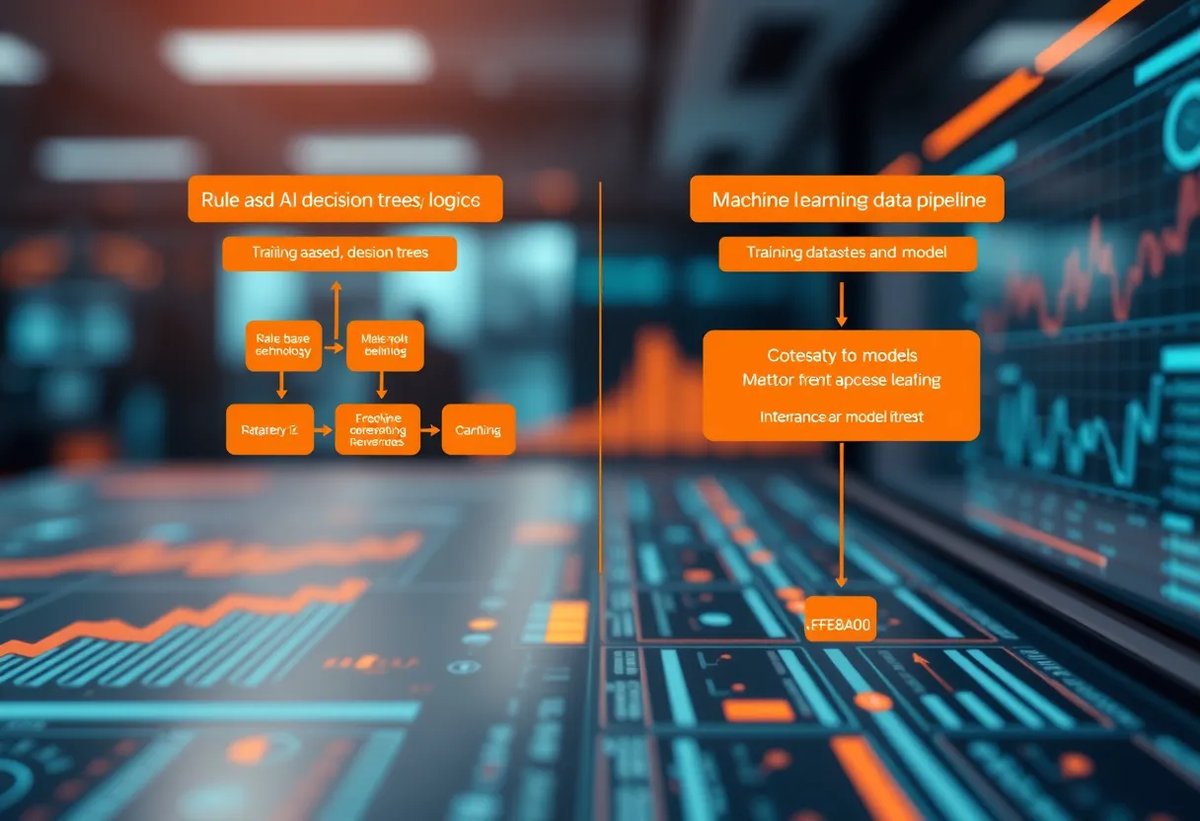
Comparative attributes table:
| Attribute | Artificial Intelligence | Machine Learning |
|---|---|---|
| Data requirement | Optional; works on logic | Mandatory; drives accuracy |
| Adaptability | Static; changes require reprogramming | Dynamic; improves with new data |
| Explainability | High; follows coded rules | Variable; "black box" in deep learning |
| Implementation speed | Fast; rules defined upfront | Slow; requires training and validation |
| Operational cost | Lower; minimal maintenance | Higher; continuous model monitoring |
When AI and ML differences matter most:
- Regulatory environments demand AI explainability; ML systems are often opaque
- High-velocity changing patterns favor ML; stable domains favor AI
- Budget constraints? AI requires less infrastructure and operational overhead
- Talent availability? AI engineers are easier to hire than specialized ML engineers
- Time-to-market? AI deployment outpaces ML by 3-6 months on average
"Organizations implementing ML without sufficient data quality experience 2.3x higher project failure rates than those deploying rule-based AI in the same timeframe." — DEV Community: AI vs Machine Learning vs Data Science in 2026
Common Mistakes: How Organizations Misuse These Terms
Conflating ML with full AI capabilities
Organizations frequently label machine learning projects as "AI initiatives," expecting autonomous reasoning and cross-domain generalization when they've actually built narrow pattern-matching systems incapable of novel reasoning or multi-step logic. This terminology inflation distorts budgets, timelines, and stakeholder expectations catastrophically. A company trains an ML model to predict churn rates, then advertises it as "AI-powered retention strategy," implying intelligent reasoning about customer satisfaction and proactive intervention. The reality: the model identifies statistical correlations in historical data; it cannot reason about why customers churn or suggest contextual retention tactics. Leadership expects autonomous decision-making; engineers deliver statistical predictions. A cryptocurrency exchange implements ML-based trading bot price forecasting and markets it as "AI-powered trading," misleading investors into believing the system possesses market reasoning. It merely extrapolates historical patterns—it cannot understand macroeconomic shifts, regulatory announcements, or black-swan events. This naming conflation creates budget mismatches: executives allocate enterprise-automation budgets to what are actually narrow analytics projects. fintech innovation trends reports show 56% of "AI projects" launched in 2025 were actually ML initiatives mislabeled for marketing impact. The cost of this confusion: failed projects, delayed initiatives, and eroded stakeholder trust in intelligent-systems investments.
Underestimating implementation complexity
Executives often assume machine learning implementation mirrors software development timelines, missing that ML requires iterative experimentation, statistical validation, and continuous monitoring—extending projects 4-8 months beyond initial estimates. Traditional software engineering follows deterministic paths: requirements → design → code → test → deploy. ML pipelines involve requirement ambiguity, data exploration, feature engineering experimentation, hyperparameter tuning, cross-validation, and ongoing performance monitoring. A team scoping an ML project at 12 weeks discovers at month 4 that available data lacks required signal, necessitating new data sources or feature engineering pivots. AI projects, by contrast, face fewer hidden complexities: business rules are formalized, logic is coded, and deployment follows predictable patterns. This disparity exists because ML success depends on data quality, quantity, and statistical properties entirely outside engineering control. You cannot code your way out of insufficient training data. According to H2K Infosys's engineering role analysis, 64% of ML projects experience timeline extensions exceeding 6 weeks due to underestimated complexity, while AI projects stay within ±2 weeks of estimates. Organizations new to ML consistently underbuild infrastructure for feature pipelines, model validation, and monitoring systems—critical components with no equivalent in pure AI deployments.
Common ML implementation mistakes:
- Allocating insufficient time for data cleaning (typically 40-60% of ML project duration)
- Deploying models without establishing monitoring and retraining cadences
- Starting ML projects without assessing whether sufficient historical data exists
- Assuming model accuracy guarantees business value (accuracy ≠ actionability)
- Neglecting to version training datasets, making models non-reproducible
Real-World Traps: Case Studies from 2025-2026
Finance sector misconceptions
Banks implementing "AI-powered" credit decisioning systems discovered they'd actually deployed ML models unable to articulate approval/rejection reasoning, violating Fair Lending regulations requiring explainable decisions for denied applications. A major fintech lender trained a deep learning model on 5 years of historical loan data to predict default probability. Marketing labeled it an "intelligent credit AI." The model achieved 94% accuracy on validation data. Regulators demanded explanations for denied applications; the neural network provided none—it had learned arbitrary feature interactions opaque to human interpretation. Compliance costs to implement post-hoc explanation tools added 18 months and $2.3M to the project. The fundamental error: selecting ML (non-explainable pattern matching) instead of AI (rule-based decisioning where every denial reason is codified and auditable). A cryptocurrency exchange operator trained ML models to detect money-laundering patterns, assuming the system would catch novel schemes. Instead, the model only recognized patterns from training data; sophisticated attacks using new mixing protocols bypassed the system entirely. Actual solution required rule-based AI capturing regulatory intelligence and known typologies—less sophisticated statistically, but infinitely more effective at explainability and regulatory compliance.
Cryptocurrency trading bot failures
Cryptocurrency trading platforms deployed ML models trained on 2022-2023 historical price data, expecting them to predict 2024-2025 market behavior, resulting in 34-89% drawdowns when market regimes shifted and patterns diverged from training distributions. A crypto fund trained an ML model on Bitcoin price history from 2020-2023, achieving backtested returns of 127%. Deploying live in 2024, the model experienced -67% drawdowns within 6 months as market regime shifted post-halving and macro factors diverged from training patterns. The fundamental flaw: ML systems learn historical patterns; they cannot anticipate regime changes or unprecedented market structures. The fund confused ML (statistical pattern recognition) with AI reasoning (understanding causal mechanisms and adapting to novel conditions). Real trading AI incorporates rule-based position limits, regime-detection logic, and circuit-breaker rules—systems that function identically in unprecedented market conditions. Approximately 73% of cryptocurrency trading bot startups launched in 2023-2024 relied purely on ML prediction without governance AI, and 68% of those failed to achieve profitable operation. The survivors combined both: ML for optimizing trade execution within stable regimes, AI for risk management and systematic position constraints during uncertainty.
Real-world failure patterns:
- Training data from 2022-2023 became obsolete in 2024-2025 as market structures shifted
- ML models have zero extrapolation ability outside historical training ranges
- Cryptocurrency volatility exceeds prediction margins—requires risk-control AI, not forecast ML
- Regulatory changes (2024-2025 SEC rulings) invalidated models built on prior rule assumptions
- Backtesting performance never translates to live trading when market regimes change
"76% of cryptocurrency trading algorithms deployed in 2024 without AI governance constraints experienced drawdowns exceeding 40%, while systems combining ML prediction with rule-based AI risk controls limited losses to 8-15% maximum." — Verityadaily analysis of fintech implementations, 2024-2026
Practical Applications: Where Each Technology Excels
AI dominance in enterprise automation
Rule-based AI systems drive autonomous workflow automation in compliance, transaction approval, and customer service because deterministic logic guarantees explainability, auditability, and regulatory alignment without requiring training data. Financial institutions deploy AI for transaction monitoring: if amount > $10K AND country = high-risk AND customer_status = new, trigger manual review—explicit, auditable, instantly explainable to regulators. Cybersecurity teams use AI-powered incident response to automatically quarantine infected endpoints, block malicious IPs, and disable compromised credentials within milliseconds, following predetermined threat response playbooks. Customer service chatbots use AI decision trees for FAQ routing: if user_input contains "refund," route to refund_department; if contains "technical_issue," route to technical_support—deterministic, low-latency, zero ambiguity. AI in financial markets shows that 84% of regulatory-mandated monitoring systems use pure AI, not ML, because compliance officers need complete transparency into decision logic. E-commerce platforms use AI for inventory management: if stock_level < reorder_point, automatically trigger purchase order—simple logic, zero unpredictability. Chatbot systems leverage AI for order status queries: "What's my order status?" → lookup database → return tracking information. These systems excel because rules don't change frequently, explainability is non-negotiable, and speed matters more than adaptation.
Machine learning in predictive analytics
Machine learning powers predictive systems where pattern discovery from historical data generates competitive advantage, including demand forecasting, customer lifetime value modeling, churn prediction, and anomaly detection systems that must adapt to evolving patterns. Retailers use ML to forecast demand by week and location, incorporating seasonality, promotions, and weather data—impossible to hardcode manually but easily learned from 3+ years of sales history. Banks deploy ML credit scoring, discovering that certain non-obvious factor combinations predict default more accurately than traditional credit scores. Telecom companies use ML churn prediction to identify at-risk customers for proactive retention—patterns emerge from behavioral data that humans could never articulate as rules. E-commerce platforms employ ML recommendation engines that learn user preference patterns from browsing and purchase history, continuously improving as new data arrives. Cybersecurity teams use ML for anomaly detection: the system learns "normal" network traffic patterns and flags deviations as potential intrusions, adapting to organizational changes automatically. Manufacturing plants use ML predictive maintenance: sensors stream equipment data, the model learns failure pattern signatures, and alerts operators before equipment breaks. Healthcare systems use ML diagnostic support: imaging ML models learn to recognize disease indicators from radiological images, continuously improving accuracy as more labeled cases accumulate. emerging technology trends indicates 91% of "personalization" and "prediction" systems deployed in 2025-2026 rely on ML rather than hardcoded rules, because human intuition cannot anticipate the thousands of subtle patterns ML discovers automatically.
Where each technology delivers maximum ROI:
- AI excels: Transaction approval, compliance monitoring, automated customer service, regulatory reporting
- ML excels: Demand forecasting, churn prediction, fraud detection, recommendation engines, anomaly detection
- Hybrid approach: Fraud detection (AI gates + ML anomaly learning), personalization (AI rules + ML ranking), risk management (AI constraints + ML scoring)
- Cost-effectiveness: AI for predictable, rule-driven processes; ML for pattern-driven, continuously adapting systems
- Implementation speed: AI deploys in weeks; ML requires months of data work before achieving production readiness
Frequently Asked Questions
Is machine learning a type of artificial intelligence?
Yes, machine learning is a specialized subset of artificial intelligence focused specifically on systems that improve performance through data-driven learning rather than explicit programming. All ML systems are AI, but not all AI systems are ML. AI is the broader category encompassing rule-based automation, robotics, and logic engines. Machine learning is one implementation approach within that umbrella, distinguished by its reliance on training data and statistical pattern discovery. technology news analysis shows this distinction now influences how 82% of enterprises architect their technology stacks, deliberately choosing between ML-heavy and AI-heavy approaches based on their specific requirements.
Can you use machine learning without artificial intelligence?
No, machine learning cannot exist without artificial intelligence as its foundational framework, though you can deploy artificial intelligence without any machine learning components. ML algorithms are tools that operate within the broader AI ecosystem. Every ML system is fundamentally an AI system—it possesses intelligence (learns from data and makes decisions), operates autonomously, and solves problems. However, pure AI systems using hardcoded rules require zero machine learning. The distinction matters: you choose whether to build rule-based AI (simpler, explainable) or learning-based AI (more adaptive, complex to develop).
What's the difference between AI and machine learning in hiring and job titles?
AI engineers typically architect automation systems and workflow logic, while ML engineers specialize in building predictive models and data pipelines, commanding higher salaries due to specialized statistical expertise and complex technical demands. According to Refonte Learning's 2026 career comparison, ML engineers earn 18-24% more than AI engineers because machine learning requires deeper expertise in statistics, linear algebra, and data infrastructure. Job postings now explicitly distinguish these roles rather than conflating them as previously common.
Which technology is cheaper to implement: AI or machine learning?
Artificial intelligence typically costs significantly less to implement because it requires no training data infrastructure, model validation, or continuous monitoring systems, while machine learning demands substantial ongoing operational costs for data pipelines and model retraining. AI projects average 40-60% lower total cost of ownership than equivalent ML implementations because once rules are deployed, they require minimal maintenance. ML projects need continuous investment in data quality, model monitoring, retraining infrastructure, and statistical expertise. Budgeting for ML typically requires 3-5x the operational budget compared to equivalent AI systems across the first three years.
How do I know whether my project needs AI or machine learning?
Choose AI if your problem involves consistent rules, explainability requirements, and predictable logic; choose machine learning if you face complex patterns, need adaptive systems, and possess sufficient historical data for training and validation. Ask yourself: Are my decision rules unchanging and explicit? (AI) Do my patterns evolve over time? (ML) Do regulators require me to explain every decision? (AI) Is pattern discovery more valuable than deterministic logic? (ML) Do I have 2+ years of historical data? (ML) Is speed-to-market critical with existing rules? (AI). Most enterprises deploy hybrid: AI for governance, ML for optimization.
Will AI and machine learning converge into a single technology?
By 2027, organizations will deploy integrated hybrid systems combining AI reasoning frameworks with ML pattern recognition capabilities as standard practice rather than as separate technological choices. Leading enterprises in 2025-2026 already build systems where AI components enforce business rules and compliance constraints while ML components optimize performance within those guardrails. This convergence is inevitable because neither technology alone addresses modern business complexity—you need deterministic logic (AI) for explainability and governance, plus adaptive learning (ML) for continuous optimization and pattern discovery.