Best CD Rates Today (October 2026): Up to 5.00% APY

The best CD rate today is 5.00% APY, offered by Nuvision Credit Union on a 7-month special with a $1,000 minimum deposit - and Popular Direct matches it on a 5-year term with a $10,000 minimum. Top 1-year money earns 4.75% at E*TRADE, while branch giants like Chase still pay as little as 0.01% on standard certificates. Here are the offers actually worth opening this October.
Quick answer
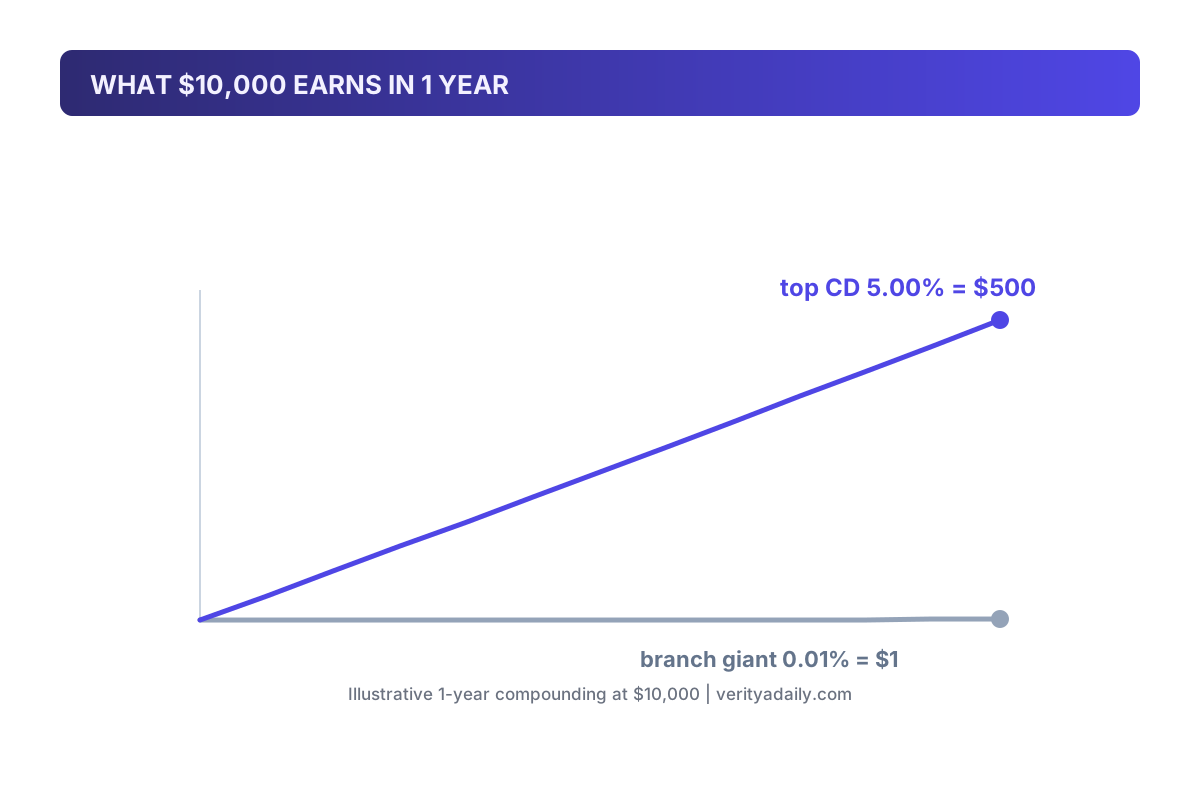
Top CD rates today (October 16, 2026): 5.00% APY - Nuvision Credit Union 7-month special ($1,000 min) and Popular Direct 5-year ($10,000 min). Best 1-year: 4.75% (E*TRADE, $0 minimum). Best 6-month: 4.50% (Synchrony). Best 11-month big-name: 4.40% (Capital One, $0 min). A $10,000 deposit at 5.00% APY earns ~$500 in one year, FDIC/NCUA-insured.
In this guide
- Today's top CD rates
- CD rates by term (6-month to 5-year)
- Big banks vs online banks: the APY gap
- CD calculator: what you'll earn
- Are CDs worth it in October 2026?
- CD vs high-yield savings vs money market
- Jumbo CDs: is $100,000 in a CD smart?
- No-penalty, share certificates and IRA CDs
- CD ladder strategy
- How to open a CD and lock the rate
- FAQ
Key takeaways
- Top national rate: 5.00% APY - Nuvision Credit Union (7-month, $1,000 min) and Popular Direct (5-year, $10,000 min) both pay it today.
- Short terms are winning: the best 6- to 11-month offers (4.40%-4.50%) sit within half a point of 5-year rates - you're not paid much to lock up money longer.
- Big banks lag badly: Chase's standard CDs start near 0.01% APY; the gap to online banks is up to 4.74 percentage points.
- Fed cross-currents: with recent inflation data keeping rate-hike talk alive, short CD terms let you re-lock higher if rates climb.
- Credit unions are the quiet winners: Nuvision, Quorum and USAlliance beat most banks - NCUA insurance protects them to $250,000.
Today's top CD rates (October 16, 2026)
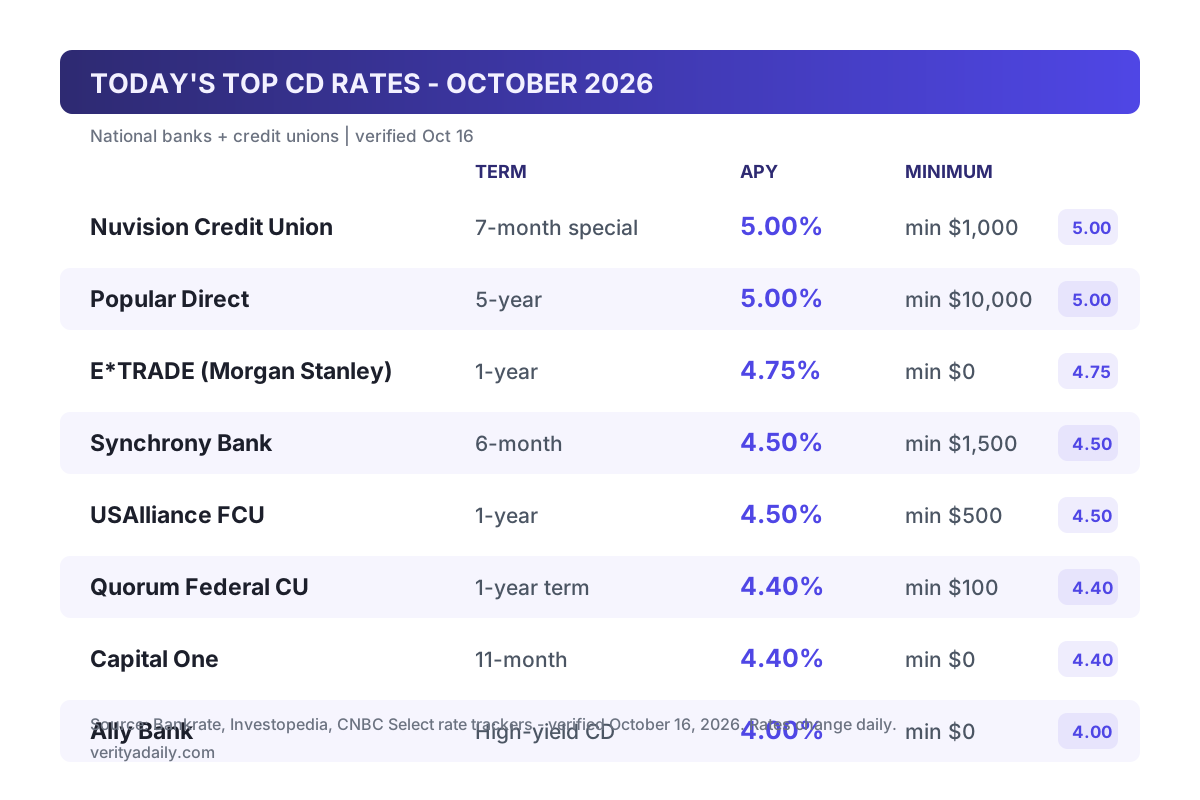
These are the strongest nationally available offers right now, verified against Bankrate, Investopedia and CNBC Select trackers this morning. Every account below is FDIC- or NCUA-insured to $250,000 per depositor.
| Institution | Term | APY | Minimum |
|---|---|---|---|
| Nuvision Credit Union | 7-month special | 5.00% | $1,000 |
| Popular Direct | 5-year | 5.00% | $10,000 |
| E*TRADE (Morgan Stanley) | 1-year | 4.75% | $0 |
| Synchrony Bank | 6-month | 4.50% | $1,500 |
| USAlliance Federal CU | 1-year | 4.50% | $500 |
| Quorum Federal CU | 1-year term | 4.40% | $100 |
| Capital One | 11-month | 4.40% | $0 |
| Ally Bank | High-yield CD | 4.00% | $0 |
Rates verified October 16, 2026 via Bankrate, Investopedia, CNBC Select and WSJ Buy Side trackers. APYs change daily - confirm on the bank's page before funding.
CD rates by term (6-month to 5-year)
Term selection matters more than usual this month. The yield curve is nearly flat at the short end: you earn 4.50% for just 6 months with Synchrony, and only half a point more if you lock five full years with Popular Direct. That's a thin reward for illiquidity.
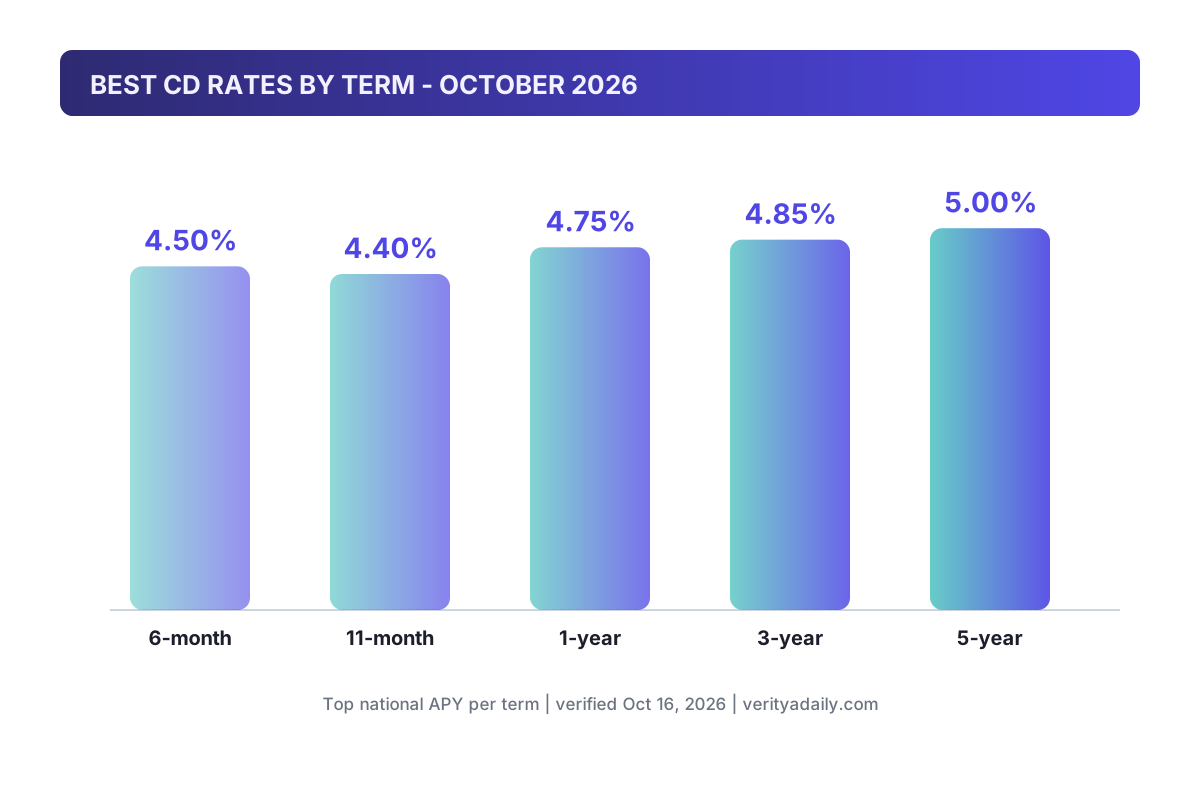
- 6 months: Synchrony leads at 4.50% APY ($1,500 minimum) with a 15-day best-rate guarantee after opening.
- 11 months: Capital One pays 4.40% with no minimum - the best big-name short lock.
- 1 year: E*TRADE tops the table at 4.75% APY with no minimum; USAlliance (4.50%, $500) and Quorum (4.40%, $100) are strong credit-union backups.
- 3 years: Popular Direct offers 4.85% ($10,000 minimum).
- 5 years: Popular Direct again at 5.00% APY - the only five-year lock we'd consider at this curve.
Our read: at today's curve, the sweet spot is the 7-month to 1-year range. You keep flexibility to re-lock if rates rise, and you sacrifice almost nothing in yield.
Big banks vs online banks: the APY gap
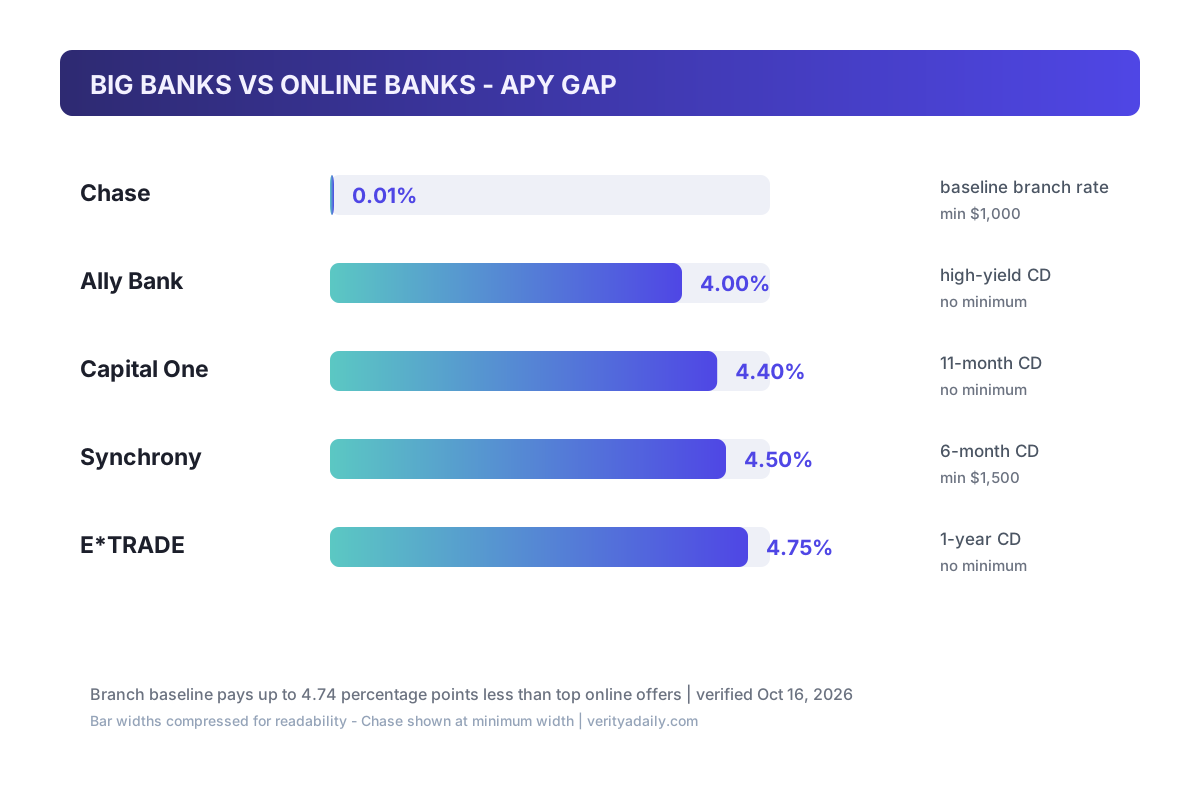
Branch networks still matter for checking accounts and cash deposits - but for CDs they're expensive. Here's what the same $10,000 earns depending on where you park it:
| Institution | Best CD APY | Catch |
|---|---|---|
| Chase | 0.01% (standard) | Relationship rates need linked JPMorgan Private Client; otherwise near-zero |
| Wells Fargo | ~3.25% on savings (Platinum) | Standard CDs require $2,500; specials need $5,000+ |
| Capital One | 4.40% | None material - no minimum, no monthly fee |
| Synchrony | 4.50% | $1,500 minimum; online-only |
| E*TRADE | 4.75% | Brokerage account context; no minimum |
The pattern repeats every rate cycle: money follows the absence of branches. Online banks have no real-estate overhead, and they pass it into APY. The only reasons to buy a CD from Chase or Wells Fargo are convenience and existing relationships - and at a 4-plus-point gap, convenience costs thousands.
CD calculator: what you'll actually earn
APY already includes compounding, so the math is simple. Plug in your numbers - the widget runs entirely on this page, nothing is sent anywhere.
🧮 CD earnings calculator
Are CDs worth it in October 2026?
Worth it if you value certainty. Here's the honest case both ways:
The case for locking now: recent inflation surprises have put rate hikes back in the news cycle - but hiking cycles eventually flip, and when they do, deposit rates follow down. A 5.00% APY lock today is a guaranteed, insured $5,000 per $100,000 per year that no market dip can touch. CDs also out-punish inflation anxieties: your principal never moves.
The case for waiting (or staying short): if rates do climb, today's 5-year locks at 5.00% could look stale against next year's offers. That's the strongest argument for the 7-month to 1-year sweet spot - take the strong rate now, keep the option to re-lock higher.
Verdict: for cash you won't touch for 6-12 months, yes - today's short-term rates are among the best risk-free returns available. For money needed sooner, a no-penalty CD or high-yield savings is the better tool.
CD vs high-yield savings vs money market
| Feature | CD (best today) | High-yield savings | Money market |
|---|---|---|---|
| Top APY now | 5.00% fixed | ~3.10-4.00% variable | ~3.50-4.30% variable |
| Rate locked? | Yes - full term | No - moves with Fed | No |
| Early access | Penalty (months of interest) | Anytime | Anytime (limits may apply) |
| Best for | Known timeline | Emergency fund | Large balances + check access |
NerdWallet's most-compared query says it plainly: people weigh a 1-year CD against money market funds. Rule of thumb - fixed timeline → CD; unknown timeline → savings; large balance needing some liquidity → split across both. Our high-yield savings guide covers the variable-rate side in depth.
Jumbo CDs: is putting $100,000 in a CD smart?
It's one of the most-asked questions on this topic, and the answer is: smart for protected money, wasteful if it's your entire liquidity. At today's 5.00% top rate, a $100,000 jumbo CD earns about $5,000 in year one, insured to $250,000 by FDIC or NCUA.
- Do it when: the money is truly surplus - house down payment in 12-18 months, business proceeds parked, retirement cash beyond your emergency fund.
- Don't if: it's your only savings. One medical bill shouldn't force an early-withdrawal penalty (typically 3-12 months of interest depending on term).
- Smart version: jumbo ladder - five $20,000 rungs (see below) keeps $20,000 accessible every six months while earning near-top rates.
Note that jumbo-specific rates ($100,000+) barely beat standard offers anymore - banks no longer need to bribe large deposits. Ignore "jumbo" marketing unless the APY is genuinely higher.
No-penalty CDs, share certificates and IRA CDs
Three niche products answer three different needs:
No-penalty CDs let you withdraw early without forfeiting interest, in exchange for a slightly lower APY (typically 0.3-0.5 points below the best fixed rates). They're the bridge between savings and CDs when your timeline is fuzzy - ideal if you might need the cash for a job change or home purchase.
Share certificates are simply CDs issued by credit unions - the name differs, the mechanics don't. You commit a deposit for a term at a fixed APY; early withdrawal costs dividends. Because credit unions are member-owned non-profits, their rates (Nuvision 5.00%, Quorum 4.40%) consistently beat bank averages, and NCUA insurance is the equivalent of FDIC. Membership is usually easier than people fear - many require only a small donation to a partner charity.
IRA CDs hold a CD inside a retirement account: the interest grows tax-deferred (traditional) or tax-free (Roth). Same rates as the bank's standard CDs, extra paperwork. Worth considering only if you've maxed better retirement vehicles and want zero-risk bonds inside your IRA.
CD ladder strategy: the smart way to lock in
A ladder splits your deposit across staggered terms so a portion matures regularly - you capture long-term rates without surrendering all liquidity.
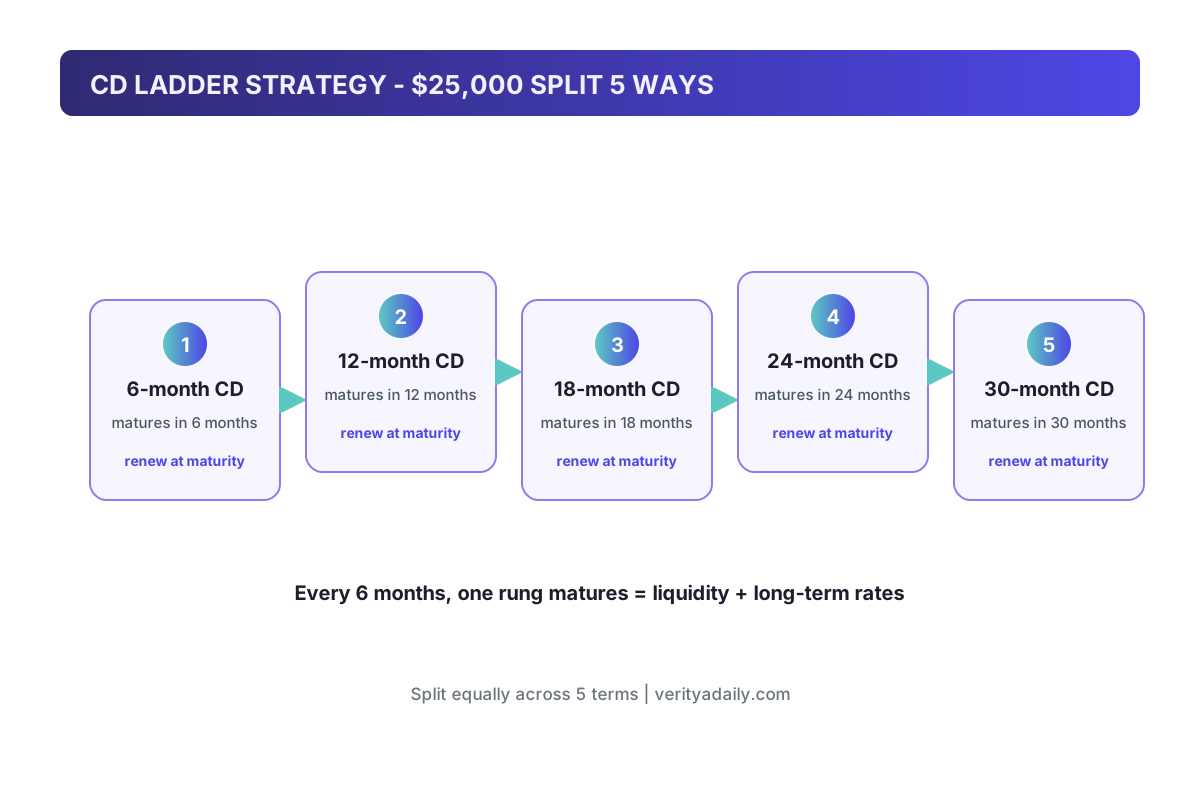
Example with $25,000: $5,000 into 6-, 12-, 18-, 24- and 30-month CDs. When the first rung matures, you reinvest it at the longest term - after two years, every rung pays long-term rates and $5,000 matures every six months. In a falling-rate environment the ladder locks today's yields; in a rising one, you're never more than six months from re-locking higher. Either way you win the middle path.
How to open a CD and lock today's rate
- Pick your term using today's curve - the 7-month to 1-year band pays nearly as much as 5-year locks (see the by-term section above).
- Verify the APY on the bank's own page before applying - aggregator tables can lag a day; the rate you see at application is the one that counts.
- Fund within the funding window. Most online banks give 7-10 days after approval to move money; the APY lock usually applies to the application date.
- Choose your maturity instruction: auto-renew into the same term (default) or mature-to-savings. If you're laddering, set a calendar reminder 7-10 days before maturity - the grace window to change instructions without penalty is short.
- Confirm insurance: FDIC for banks, NCUA for credit unions, $250,000 per depositor per institution. Ladder amounts above that across two institutions.
Early-withdrawal penalties are standardized but steep: roughly 3 months of interest on terms of a year or less, 6-12 months on longer terms. That's the real cost of breaking a CD - not a fee, but surrendered yield.
FAQ
What is the highest CD rate offered today?
As of October 16, 2026, the top nationally available rate is 5.00% APY - from Nuvision Credit Union's 7-month special ($1,000 minimum) and Popular Direct's 5-year CD ($10,000 minimum). Both are listed in our top-rates table above with the next-best offers by term.
Is it smart to put $100,000 in a CD?
If it's money you won't need and want fully insured: yes - it earns roughly $4,400-$5,000 over a year at today's best rates. Split it as a five-rung ladder so $20,000 matures every six months, and keep a separate emergency fund so you're never forced into an early-withdrawal penalty.
How do share certificates work?
A share certificate is a credit union's version of a CD: fixed deposit, fixed term, fixed APY, penalty for early withdrawal. Credit unions often pay more than banks because they're member-owned, and accounts are NCUA-insured to $250,000 - the exact equivalent of FDIC coverage.
Which bank has the best fixed deposit rate?
In the US, "fixed deposit" = certificate of deposit. Today the best national rates come from online-first institutions: Nuvision Credit Union and Popular Direct lead at 5.00% APY, with E*TRADE at 4.75% for one year. Branch giants like Chase pay as little as 0.01% on standard CDs - location costs yield.
Are CDs worth it in October 2026?
For money with a known timeline, yes: 4.40%-5.00% APY is a strong risk-free return, and with inflation surprises keeping Fed policy uncertain, short-term CDs let you lock good rates while keeping the flexibility to re-lock higher. Only park money you're certain not to touch, or use a no-penalty CD.
📚 Sources & Citations (5)
- Bankrate - Best CD Rates of October 2026 (up to 5.00%)
- Investopedia - Best CD Rates for October 2026: Lock in 5.00% APY (Nuvision 7-month)
- CNBC Select - Best CD Rates of October 2026 (Synchrony, Capital One details)
- WSJ Buy Side - Best 1-Year CD Rates (USAlliance 4.50%, E*TRADE)
- Ally Bank - High-Yield CD rates (4.00% APY, as of 10/15/2026)
Rate update note: this page is a living tracker - rates change daily and APYs were verified October 16, 2026. We refresh the table, term chart and bank comparison as offers move. Nothing here is financial advice; see our full disclaimer.
Keep exploring: decide between locked and liquid returns with our high-yield savings account explainer, build the habit that funds CDs with the best free budgeting apps, or set teens on the saver path with budgeting apps for teens. For macro context on where rates head next, read what a Fed chair Warsh means for your money.