Bitcoin has been trading in a painfully narrow range around $63,500 for weeks, and despite record ETF inflows, the price won't budge. The crypto market is stuck in limbo — and the upcoming US CPI inflation report might be the only thing that can break it free.
AdSense Ad (728×90)
The Sideways Grind
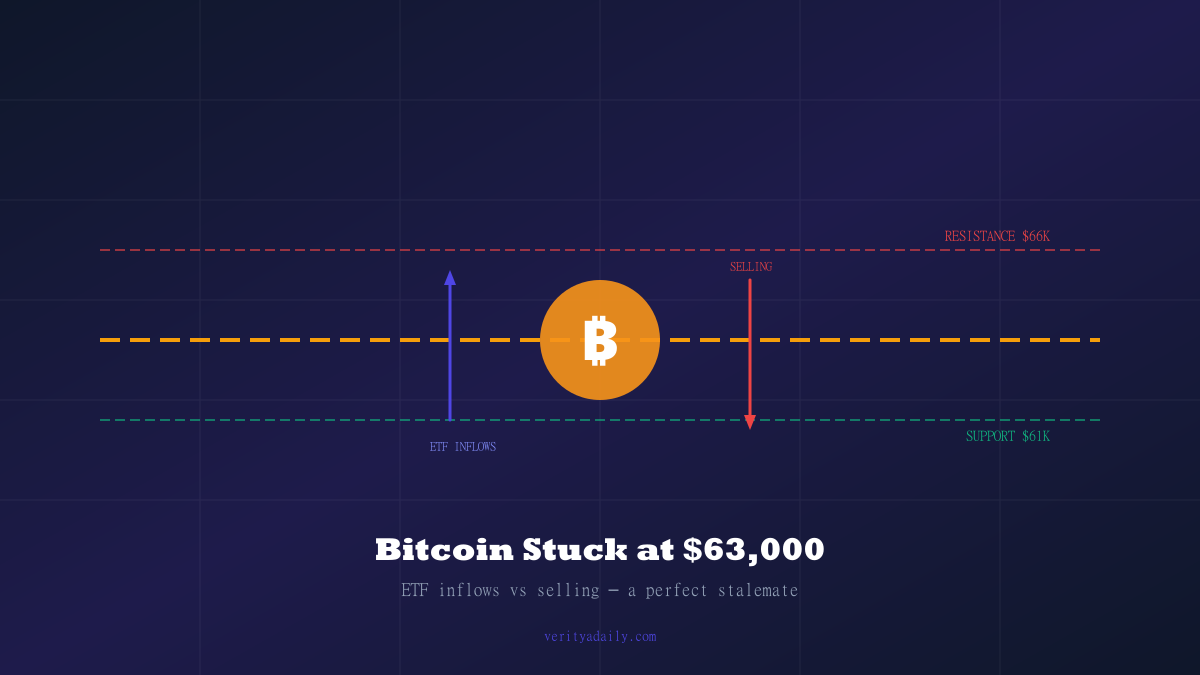
Bitcoin's volatility has cratered. For weeks, BTC has oscillated between $61,000 and $66,000 — a range so tight that options traders are calling it "the death zone." The Bollinger Bands have squeezed to their narrowest point in over a year, and trading volumes on major centralized exchanges have hit a 32-month low.
Meanwhile, DEX (decentralized exchange) spot market share has reached an all-time high, suggesting that while institutional volume is drying up, retail and DeFi activity is actually growing. The market isn't dead — it's just waiting.
ETF Inflows vs Selling — A Perfect Balance
Spot Bitcoin ETFs have been the success story of 2026. Since their approval, they've absorbed billions in institutional capital. But here's the problem: the inflows are being perfectly offset by selling from miners, long-term holders taking profits, and — surprisingly — public companies offloading their reserves.
"ETF inflows are keeping a floor under Bitcoin, but they're not strong enough to push through resistance. It's like pushing a boulder uphill that keeps rolling back." — Crypto market analyst
Strategy (MicroStrategy) Sells Bitcoin — A First
In a move that shocked the crypto community, Strategy — formerly MicroStrategy — sold 1,690 Bitcoin for the first time in its history. The company raised $653 million by selling MSTR shares, marking a significant shift in its strategy (pun intended).
CEO Michael Saylor has long been Bitcoin's loudest bull, famously pledging that MicroStrategy would never sell. This sale — while small relative to their 200,000+ BTC holdings — signals that even the most committed holders are reassessing in this sideways market.
AdSense In-content Ad
The Great Crypto Shakeout of 2026
While Bitcoin stubbornly holds $63K, the broader crypto market is in full-blown crisis mode:
- 100+ crypto projects have folded in 2026 — a dot-com style shakeout that's wiping out weak tokens and teams.
- XRP is getting left behind — despite ETF interest, XRP is dropping near $1, underperforming even in a sideways market.
- BIP-110 Bitcoin fork controversy — a contentious soft fork attempt mined only 2 blocks before stalling, creating uncertainty about Bitcoin's governance.
- Ravencoin rollback risk — two mining pools controlling most of Ravencoin's hashpower could roll back four days of transactions.
| Asset | Price | 7D Change | Trend |
|---|---|---|---|
| Bitcoin (BTC) | $63,545 | -0.67% | Sideways |
| Ethereum (ETH) | $1,879 | +0.28% | Stable |
| Solana (SOL) | $76.19 | +0.50% | Recovering |
| XRP | $1.02 | +0.90% | Weak |
| BNB | $615 | -2.69% | Declining |
CPI Report: The Catalyst Everyone's Waiting For
Wednesday's US Consumer Price Index (CPI) report is the next major potential catalyst for Bitcoin. Here's why it matters:
If inflation comes in hot: The Fed may delay rate cuts further, strengthening the dollar and putting downward pressure on risk assets including Bitcoin. Expect a test of $60,000 support.
If inflation comes in cool: Rate cut expectations return, dollar weakens, and Bitcoin could finally break through $66,000 resistance. A move to $70,000+ becomes possible.
Adding to the geopolitical complexity, oil prices have surged back to $89 after Trump demanded 50 years of Iranian compensation for the Strait of Hormuz disruption. Higher energy costs feed into inflation, which feeds back into Fed policy — and directly impacts crypto.
Update (August 16, 2026): Near the 2026 Low
Since this article was first published, Bitcoin has slid further. The price is hovering around $63,000 — very close to the 2026 low near $60,000 hit on February 6 — and is down roughly 25% year-to-date. Financial media now describe the move as a decline of about $40,000 in six weeks from the highs, with leveraged-position unwinding playing a central role: the early-June selloff below $70,000 triggered around $1.25 billion in liquidations.
The macro backdrop has not helped. A divided Federal Reserve held rates at 3.50%–3.75% at its latest meeting and signaled no near-term cuts, with Chair Kevin Warsh facing questions over still-elevated inflation. Tighter-for-longer policy keeps pressure on risk assets — and Bitcoin has behaved like one.
On the product side, Cboe has filed for the first US 3x leveraged Bitcoin and Ether ETFs, a sign that Wall Street is still building crypto infrastructure even in a bear market — and a reminder that leveraged products cut both ways when prices are falling.
The structural question from the original article — whether ETF inflows alone can break the range — remains unanswered. The range has simply moved lower.
What It Means For You
For HODLers: Patience is being tested. If you've held this long, the sideways action is painful but not unusual. Bitcoin has historically had multi-month consolidation phases before major moves.
For traders: The low volatility is actually a setup. Bollinger Band squeezes historically precede explosive moves. Position yourself for a breakout in either direction.
For new investors: The shakeout is actually healthy. 100+ dead projects means capital is concentrating into stronger assets. Bitcoin and Ethereum are where the smart money stays.
For the industry: Bitcoin-backed lending is entering its institutional era. Public companies are increasingly borrowing against BTC holdings to fund operations — a sign that Bitcoin is becoming a financial asset, not just a speculative bet.
🔑 Key Takeaways
- Bitcoin stuck in $61K-$66K range — volatility at multi-year lows
- ETF inflows offset by selling, including MicroStrategy's first-ever BTC sale
- 100+ crypto projects dead in 2026 — the great shakeout continues
- CPI inflation report is the next major catalyst — could break Bitcoin out or down
- Bitcoin-backed institutional lending is growing — BTC becoming a financial asset