
Energy Vault's $600M Texas AI Data Center Power Deal, Explained
📑 Table of Contents
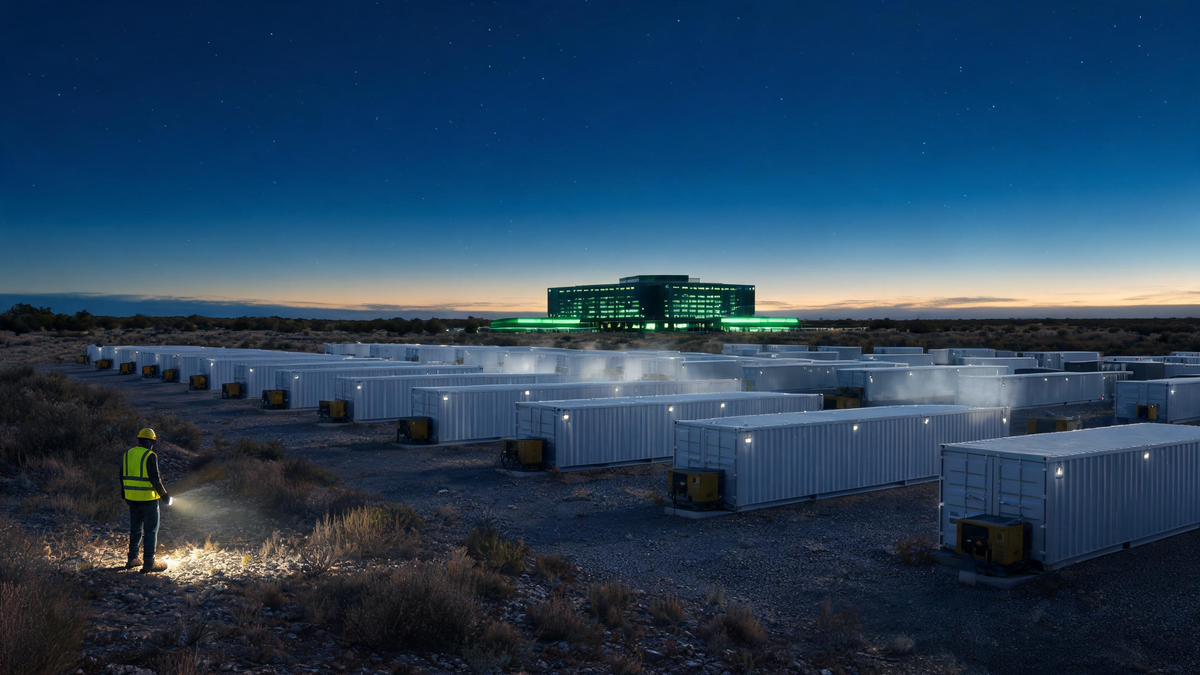
Energy Vault has signed what its chief executive calls the largest contract in company history: a strategic agreement to deliver 1.25 gigawatts of integrated power infrastructure for an undisclosed hyperscaler's AI data center in Texas. The deal pairs Energy Vault's battery storage and control software with Caterpillar generator sets, and is designed to run the facility entirely off the grid — bypassing the interconnection queues that can leave data centers waiting years for utility power.
The company expects the contract to generate roughly $500 million to $600 million in revenue across the second half of 2026 and 2027, per energy-storage.news. The customer's identity and the exact site have not been disclosed.
What was signed
The strategic agreement covers an initial 1.25 GW of integrated power infrastructure, combining three Energy Vault product lines: battery energy storage systems (BESS), grid-forming power conversion systems (PCS) — the inverters that can set voltage and frequency on their own, a key requirement for an islanded plant — and the company's AI infrastructure control software. energy-storage.news
Caterpillar will supply the generator sets and EPC (engineering, procurement and construction) services — the muscle behind what amounts to a self-contained power island. Because the plant is grid-independent, it does not need to join the utility interconnection line, and the customer's own generation rides alongside the storage.
The speed-to-power race
The most striking part of the deal is the timeline: first deployments are expected in 4–12 months. energy-storage.news
The contrast with the conventional route is instructive. Evergy, the utility serving Kansas and Missouri, recently disclosed 3 GW of signed large-load contracts — 2.5 GW of data center load under its large-load tariff plus 500 MW of smaller loads — and is planning more than 5 GW of new generation through 2032, including 3.9 GW of gas, roughly 800 MW of solar and 450 MW of battery storage. Utility Dive It is also in "advanced discussions" for another 1–2 GW. That is the traditional path: utilities building generation years ahead to serve committed load.
Energy Vault's route inverts the model: generate, store and manage power on site, under the customer's control, and get electrons flowing in months rather than years. The company's control software acts as an "operating system" for the plant, managing power flows, voltage and frequency stability, generator cycling and fuel efficiency under the highly dynamic loads that AI training and inference create.
A business-model shift
CEO Robert Piconi called the agreement "our largest single contract executed to date," framing it as the company's transition from storage pioneer to integrated energy infrastructure provider. Data Center Dynamics
Energy Vault has been building toward this for a while. In late July it broke ground on its first data center project — a modular 8 MW deployment in Snyder, Texas, with Crusoe, expandable to 25 MW. It formed a partnership with Peak Energy in February 2026, and signed a 2 GW / 20 GWh deal with RackScale in December 2024. Data Center Dynamics
Why Texas, and why now
Texas is ground zero for the AI power squeeze. Interconnection requests across the state have reached roughly 474 GW — a backlog large enough to have prompted pauses on new data center connections while utilities work through the queue.
The Energy Vault deal also lands in a remarkable week for AI power: SpaceX has said it is targeting 2 GW of compute capacity by year-end, and PPL and Blackstone unveiled a 5 GW gas-turbine partnership in Pennsylvania. Self-contained power islands of the kind Energy Vault and Caterpillar are building are becoming a standard answer to a simple problem — the grid cannot keep up with AI demand.
The open questions
The biggest unknown is the customer. An "undisclosed hyperscaler" invites speculation about which of the major AI players is behind the project, but no reporting to date identifies the counterparty, and neither do we.
The $500–600 million figure is a company expectation, not a booked or guaranteed order, and no order-book confirmation from Caterpillar has been published. Emissions and permitting details for the gas generation involved have also not been disclosed.
None of that diminishes the signal: when the grid cannot keep up with AI demand, the power is coming to the data center — not the other way around.