Microsoft has announced a quantum computing breakthrough that it claims could change the trajectory of computing forever. The company says it has created a new "state of matter" in a chip — topological superconductivity — that could make practical quantum computers a reality. But some physicists aren't convinced, and even Elon Musk has weighed in.
AdSense Ad (728×90)
What Microsoft Announced
Satya Nadella took to social media to announce what Microsoft is calling a major milestone in quantum computing. The company has developed a chip that uses topological qubits — a type of quantum bit that's theoretically more stable and less error-prone than traditional qubits used by competitors like IBM and Google.
The key innovation: Microsoft claims to have created and controlled a new state of matter called topological superconductivity. If true, this would allow quantum computers to scale without the massive error-correction overhead that plagues current quantum systems.
"This is a moment that moves us closer to a future where quantum computing can solve problems that are currently intractable for classical computers." — Satya Nadella, CEO of Microsoft
The New State of Matter Explained
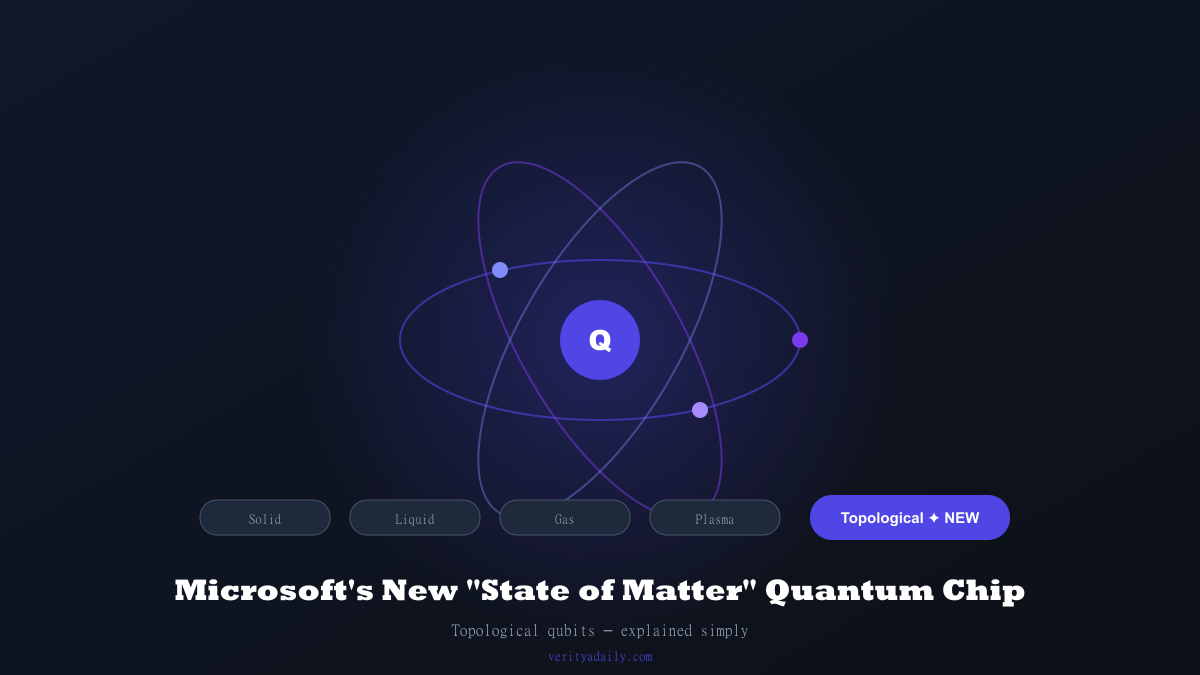
You learned about three states of matter in school: solid, liquid, gas. Physics has since identified more (plasma, Bose-Einstein condensates, etc.). Microsoft claims to have added another: topological superconductivity.
Here's the simplified version: In regular quantum computing, qubits are fragile — the slightest environmental noise (heat, electromagnetic fields) causes errors. Topological qubits encode information in the "shape" of the quantum state, not in individual particles. This makes them inherently more robust — like writing a message on a rubber band that can be stretched and twisted without losing the message.
The key ingredient is Majorana fermions — exotic particles that are their own antiparticles. Microsoft has been chasing Majorana-based quantum computing for over a decade, investing billions into research that many considered a long shot.
AdSense In-content Ad
Why Physicists Are Skeptical
Not everyone is convinced. As Nature reported, several physicists have questioned whether Microsoft has actually demonstrated the topological state. The evidence, they argue, is not conclusive — and Microsoft has a history of premature quantum announcements.
In 2021, Microsoft had to retract a major paper claiming to have observed Majorana fermions after an investigation found data irregularities. While the company has since published new research with different methodology, the scientific community's trust has been strained.
"The results are suggestive but not definitive," one physicist told Nature. "We need independent replication before this can be called a breakthrough."
| Approach | Company | Qubit Type | Stability | Status |
|---|---|---|---|---|
| Topological | Microsoft | Majorana-based | Theoretically high | Claimed breakthrough (disputed) |
| Superconducting | IBM, Google | Transmon | Moderate | Working (100-1000 qubits) |
| Trapped Ion | Quantinuum, IonQ | Ion traps | High | Working (20-50 qubits) |
| Photonic | PsiQuantum | Photons | Moderate | Early stage |
| Classical (for reference) | Intel, AMD, Apple | Silicon transistors | Extremely high | Mainstream |
Elon Musk's Reaction
Elon Musk, never one to stay quiet during a tech announcement, responded to Nadella's post with a cryptic: "More and more..."
It's unclear whether Musk was expressing genuine interest, announcing that xAI is exploring quantum computing, or simply doing what he does best — generating engagement. But the exchange between two of tech's most powerful CEOs about quantum computing sent the story viral.
Musk's companies have historically focused on AI (xAI, Tesla autopilot) and neural interfaces (Neuralink) rather than quantum computing. But if quantum computers can accelerate AI training — which Microsoft claims is a key application — Musk's interest makes strategic sense.
What This Means for Computing
If Microsoft's claim holds up to scientific scrutiny, the implications are enormous:
For AI: Quantum computers could dramatically speed up training of large AI models. Currently, training GPT-5-class models takes months and costs millions. Quantum-accelerated training could reduce this to days.
For cryptography: Practical quantum computers can break current encryption standards (RSA, ECC). This is why governments and banks are already investing in post-quantum cryptography.
For drug discovery: Quantum computers can simulate molecular interactions at a level impossible for classical computers, potentially revolutionizing pharmaceutical research.
For Microsoft: This would validate the company's decade-long bet on topological quantum computing — a bet many considered a waste of money. It would put Microsoft ahead of IBM and Google in the quantum race.
When Will Quantum Be Mainstream?
Despite the hype, practical quantum computing is still years away. Even Microsoft's most optimistic timeline puts useful quantum applications at 5-10 years out. Here's what to expect:
- 2026-2028: Research phase — proving the topological qubit works at scale
- 2028-2030: Early commercial access — cloud-based quantum computing for research institutions
- 2030-2035: Mainstream adoption — quantum-accelerated AI training, drug discovery, materials science
- 2035+: Quantum-native applications — software built specifically for quantum hardware
The key bottleneck isn't just the qubits — it's the entire ecosystem: error correction, quantum algorithms, programming languages, and developer tools all need to mature. Microsoft's breakthrough, if real, is one important piece of a much larger puzzle.
🔑 Key Takeaways
- Microsoft claims to have created a new "state of matter" for quantum computing — topological superconductivity
- Topological qubits would be more stable than traditional qubits, potentially solving quantum computing's biggest problem
- Physicists are skeptical — Microsoft previously retracted a similar claim in 2021
- Elon Musk reacted with "More and more..." — suggesting growing tech industry interest
- Practical quantum computing is still 5-10 years away, even if this breakthrough is real