The 8 Best Cryptocurrency News Websites in 2026 (Ranked by Use Case)
The best cryptocurrency news website depends on what you need. For breaking market and regulatory news, CoinDesk and Cointelegraph publish the highest volume of daily coverage. For institutional research and market-structure data, The Block and Blockworks run proprietary charts, indices, and ETF trackers. For plain-language explainers, Decrypt is the clearest starting point. No single outlet is universally authoritative — so cross-check any market-moving claim against primary sources before you act on it.
That last point matters more in 2026 than it used to. The digital-asset market peaked near $4.2 trillion in October 2025, fell to roughly $2.17 trillion by February 2026, then closed February at about $2.3 trillion, according to Nasdaq’s 2026 Digital Asset Market Report. When valuations swing that hard, the difference between reporting and recycled hype becomes an expensive one.
The 8 best crypto news websites at a glance
- CoinDesk: best for broad breaking news
- Cointelegraph: best for high-volume international coverage
- The Block: best for institutional research and market data
- Blockworks: best for institutional analysis and macro context
- Decrypt: best for accessible explainers
- Bitcoin Magazine: best for Bitcoin-only coverage
- CryptoSlate: best for rapid project and market context
- CoinMarketCap Alexandria: best for education alongside live data
How these sites were evaluated
Selection came down to source transparency, specialization, and whether an outlet separates reporting from sponsored content. Publication volume was treated as a starting signal, not proof of reliability. A site that publishes 50 articles a day but blurs the line between a press release and a news story ranks below one that publishes less and labels everything clearly.
The criteria applied to every entry:
- Sourcing: Does the outlet cite primary documents like regulatory filings, company announcements, or on-chain data?
- Transparency: Are reporting, opinion, sponsored posts, and research visibly separated?
- Data hygiene: Do price, ETF-flow, and liquidation claims carry a timestamp and a named data provider?
- Specialization: Does the outlet cover a defined beat well, or spread thin?
- Audience fit: Is it built for a retail reader, a professional analyst, or both?
Readers on r/CryptoCurrency consistently ask for substance over “1000x” token promotions and influencer shilling. Community members on r/CryptoCurrencies express the same distrust of hype and “hopeium.” The rankings below weight editorial substance accordingly.
No crypto outlet, including the ones ranked here, should be your only source for a decision. Verify market-moving claims against SEC filings, company blogs, or blockchain explorers before trading on them.
At-a-glance comparison
| Website | Best for | Standout feature | Price (2026) |
|---|---|---|---|
| CoinDesk | Broad breaking news | Markets, ETF, regulation desks | Free core news |
| Cointelegraph | High-volume international news | Global coverage across time zones | Free core news |
| The Block | Institutional research | 707 data charts, 20 indices, 119 treasury trackers | Pro custom; Campus $399 |
| Blockworks | Institutional analysis | Research after Messari acquisition | Free core news |
| Decrypt | Explainers | Plain-language Web3 and NFT guides | Free core news |
| Bitcoin Magazine | Bitcoin-only coverage | Bitcoin policy and culture focus | Free core news |
| CryptoSlate | Rapid market context | News plus project profiles | Free core news |
| CoinMarketCap Alexandria | Education plus live data | Token data and API tiers | Free API; paid from $29/mo |
1. CoinDesk: best for broad breaking news
CoinDesk covers breaking news, markets, regulation, ETFs, and institutional adoption across the whole digital-asset market. It is the default starting point when a regulatory ruling or ETF decision breaks and you need context fast. Its associated data businesses also publish indices and market information, giving reporters in-house numbers to anchor coverage.
The breadth is the point. When the SEC and CFTC issued a joint crypto-asset interpretation in 2026 clarifying how U.S. securities laws apply to certain crypto assets, broad-market outlets like CoinDesk are built to turn filings into readable analysis within hours.
Core news content has no clearly published mandatory subscription price in the sources reviewed as of 2026. That keeps the barrier to daily reading at zero.
Verdict: start here for market-wide breaking news, then confirm specifics against the underlying filing or announcement.
2. Cointelegraph: best for high-volume international coverage
Cointelegraph publishes high-volume coverage of Bitcoin, digital assets, blockchain, and market developments across international markets. Its strength is throughput and time-zone spread: news breaks somewhere at all hours, and Cointelegraph tends to have a story up quickly.
That volume cuts both ways. Readers on r/bitcoin_com note that the best outlets add original value rather than recycle headlines, and any high-frequency publisher risks filler during slow news days. Treat Cointelegraph as a fast alert layer, not a final source.
Verdict: pair it with CoinDesk for early signal, then verify before you trade on anything.
3. The Block: best for institutional research and market data
The Block covers institutional research, market structure, funding rounds, and proprietary crypto data. Its directory lists 9 news desks, 264 topics, 707 data charts, 20 market indices, 119 treasury trackers, and 8 ETF pages, according to The Block’s own directory. That data depth is what separates it from headline-driven outlets.
The treasury trackers matter in the current cycle. Digital-asset treasury companies deployed at least $49.7 billion to acquire more than 5% of total BTC and ETH supply, according to CoinGecko’s 2025 Annual Crypto Industry Report. The Block’s trackers let you follow that buying rather than read about it after the fact.
Pricing: The Block Pro is custom or undisclosed as of 2026. The Block Campus for Individuals costs $399 and includes roughly 7 hours of content across 10 subject areas with certification.
Verdict: the strongest choice for analysts who need charts and market-structure data alongside reporting.
4. Blockworks: best for institutional analysis and macro context
Blockworks targets professional and institutional readers with news, research, podcasts, newsletters, and market commentary spanning macroeconomics, DeFi, and institutional finance. It reads for people who track crypto against interest rates and traditional markets, not in isolation.
Its research capability expanded sharply in 2026: Blockworks acquired crypto research company Messari on June 12, 2026, folding Messari’s data and research into its offering. For a portfolio manager separating market-moving information from influencer noise, that combination of journalism and structured research is directly useful.
The macro framing has real teeth: Bitcoin declined 6.4% in 2025 while gold gained 62.6%, according to CoinGecko’s 2025 report — exactly the kind of cross-asset comparison Blockworks builds coverage around.
Verdict: best for readers who want crypto news set against macroeconomic context.
5. Decrypt: best for accessible explainers
Decrypt focuses on accessible cryptocurrency explainers covering Web3, gaming, NFTs, and consumer crypto. It is the outlet to hand a non-specialist colleague who needs to understand a concept before a meeting, written in plain language rather than trader shorthand.
The explainer format suits fast-changing regulation. The GENIUS Act was signed into U.S. law on July 18, 2025, creating a federal framework for permitted payment stablecoin issuers, according to the NCUA’s regulatory resources. Turning a law like that into a readable primer is Decrypt’s core competence.
Verdict: the clearest onboarding source for consumer crypto and Web3, less suited to deep institutional analysis.
6. Bitcoin Magazine: best for Bitcoin-only coverage
Bitcoin Magazine specializes in Bitcoin reporting, culture, policy, and adoption. It is built for readers who want Bitcoin coverage without altcoin and Web3 noise — a preference stated openly on r/Bitcoin, where readers criticize general outlets for publishing filler when Bitcoin news is thin.
That focus is a genuine differentiator. Spot Bitcoin ETFs attracted roughly €34 billion in net inflows since their January 2024 launch, according to the European Securities and Markets Authority. A Bitcoin-only outlet tracks the policy and adoption story around flows like that in depth rather than as one item among many.
Verdict: the right pick if your mandate is Bitcoin and you find broad crypto sites diluted.
7. CryptoSlate: best for rapid project and market context
CryptoSlate combines rapid news summaries with project profiles and market intelligence. It is useful for getting quick context on a project or market move before you consult primary documents or deeper research. Think of it as a fast orientation layer.
Speed has value in a market this fragmented. One recurring complaint on X is that traders drown in heatmaps, open interest, order flow, and trend indicators — which raises the value of clear synthesis. CryptoSlate’s project profiles offer that synthesis before you go deeper.
Verdict: a strong second stop for fast context, not a substitute for primary-source verification.
8. CoinMarketCap Alexandria: best for education alongside live data
CoinMarketCap Alexandria pairs educational material, definitions, and token data with CoinMarketCap’s live market-data platform. It answers the “what is this and what is it worth right now” question in one place — ideal for readers learning the market while watching prices.
The data side is where the paid product lives. The CoinMarketCap API Basic plan is free as of 2026 with 15,000 monthly call credits and 60-second updates. Paid tiers scale up: Builder $29/month (150,000 credits), Startup $79/month (450,000 credits, WebSocket), Growth $299/month (2M credits), Professional $699/month (5M credits).
Verdict: best for learners and developers who want education next to programmable market data.
Other options considered
A few sources sit outside the core eight but earn a mention. Perception’s outlet directory and Paybis’s crypto news roundup both aggregate a wider field of publications if you want to build your own daily rotation.
For a concise daily summary across technology, cryptocurrency, and finance in one email, The Daily Brief from Verityadaily — our newsletter — delivers a morning briefing at no cost. Verityadaily publishes independent reporting and original analysis, and the newsletter suits readers who want one digest rather than monitoring a dozen feeds. It is a summary layer, not a replacement for the primary sources above.
Why crypto coverage has to span more than prices
Reliable crypto news now has to cover regulation, stablecoins, ETFs, treasury-company buying, derivatives, DeFi, and financial stability. Token prices alone miss most of the story.
The numbers show why. Stablecoin market capitalization reached about $317 billion as of April 6, 2026 — more than 50% growth since early 2025, according to the Federal Reserve. Stablecoins made up roughly 30% of on-chain transaction volume and generated more than $4 trillion in volume in the first part of 2025, per TRM Labs. Decentralized-exchange perpetual trading volume hit $6.7 trillion in 2025, up 346% year over year, according to CoinGecko.
Regulation moves the market too. MiCA imposes organizational, operational, and prudential requirements on crypto-asset issuers and service providers across the EU, according to the European Commission. An outlet that ignores these threads gives you an incomplete picture no matter how fast it publishes prices.
Frequently Asked Questions
Where can I find the latest cryptocurrency news for free?
CoinDesk, Cointelegraph, Decrypt, Bitcoin Magazine, and CryptoSlate all publish free core news content as of 2026. CoinDesk and Cointelegraph offer the highest volume of breaking coverage, while Decrypt is the most accessible for beginners. For a free daily summary across crypto, tech, and finance in one email, The Daily Brief from Verityadaily delivers a morning briefing at no cost.
Which crypto news site is most reliable?
Reliability depends less on brand size than on sourcing and transparency. The most reliable outlets cite primary documents, separate reporting from sponsored content, and attach timestamps and data providers to price and ETF claims. The Block and Blockworks lead on institutional sourcing and research depth. Whichever outlet you use, cross-check market-moving claims against regulatory filings, company announcements, or blockchain data before acting on them.
Where can I track live crypto prices and market capitalization?
CoinMarketCap’s live platform, paired with its Alexandria educational content, is the most common source for live prices, token rankings, and market-cap data. Its API Basic plan is free with 15,000 monthly call credits and 60-second updates as of 2026. The Block also publishes 707 data charts and 20 market indices for professional readers.
Which site is best for Bitcoin-only news?
Bitcoin Magazine is the strongest choice for Bitcoin-specific coverage, focusing on policy, culture, adoption, and the Bitcoin ecosystem without altcoin or Web3 filler. Readers on r/Bitcoin specifically prefer sources that stay on Bitcoin rather than general outlets that publish unrelated content during slow news periods.
Which sources cover crypto regulation and institutional adoption?
The Block and Blockworks lead on institutional and regulatory coverage, with proprietary treasury trackers, ETF data, and research. CoinDesk covers regulation and institutional adoption across the broad market. All three are built to turn documents like the 2026 SEC and CFTC joint crypto interpretation into usable analysis quickly.
Do I still need paid crypto research if I read free news sites?
It depends on your role. Free outlets cover breaking news well, but professional analysts and portfolio managers often need structured research and data that free feeds don’t provide. The Block Campus costs $399 for individuals, Blockworks expanded its research through the Messari acquisition in June 2026, and CoinMarketCap’s paid API tiers start at $29 per month for historical data access.
Sources
- Nasdaq — 2026 Digital Asset Market Report ($4.2T peak, $2.17T trough)
- The Block Directory — 707 charts, 20 indices, 119 treasury trackers
- CoinGecko — 2025 Annual Crypto Industry Report ($49.7B treasury deployments, DEX volume)
- Federal Reserve — stablecoin market cap ~$317B (April 2026)
- TRM Labs — 2025 Crypto Adoption and Stablecoin Usage Report
- ESMA — €34B spot Bitcoin ETF inflows since Jan 2024
- European Commission — MiCA requirements for issuers
- CoinMarketCap API pricing — free Basic tier, paid scales
Read Next
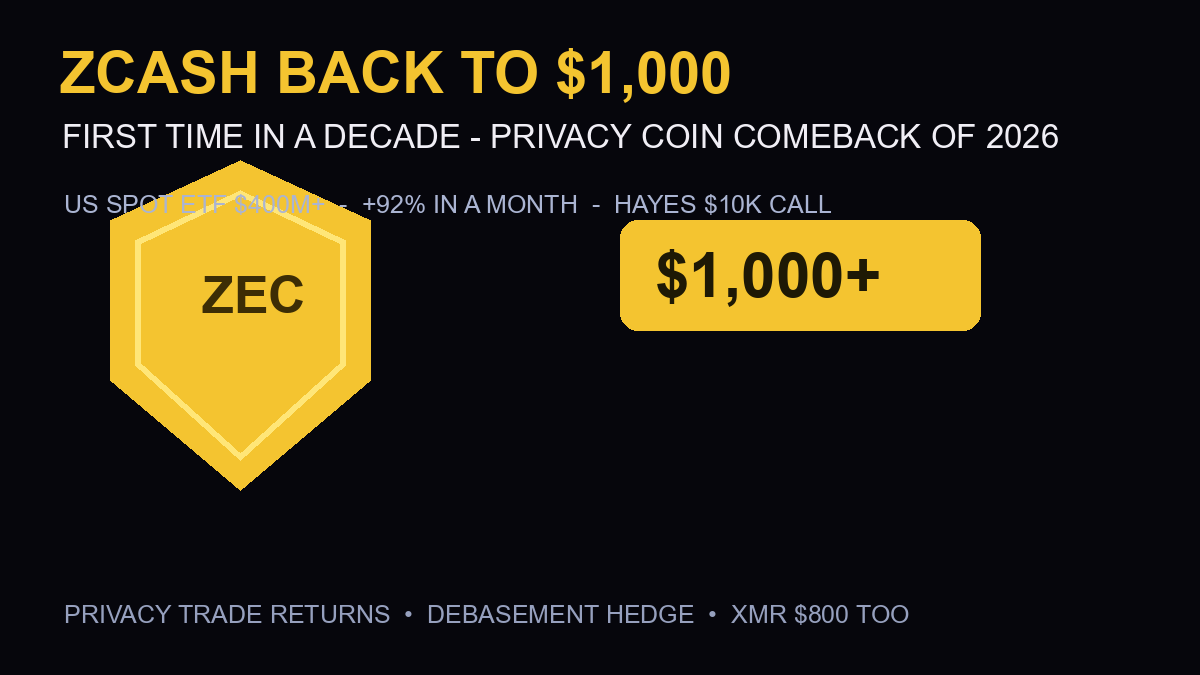
Zcash Hits $1,000: The Privacy Coin Comeback of 2026

GPT-6 Astra: The “AGI Era” Claim + Security Lockdown