AI Music Detectors: We Compared the Claims — Deezer, IRCAM and the 99% Accuracy Illusion
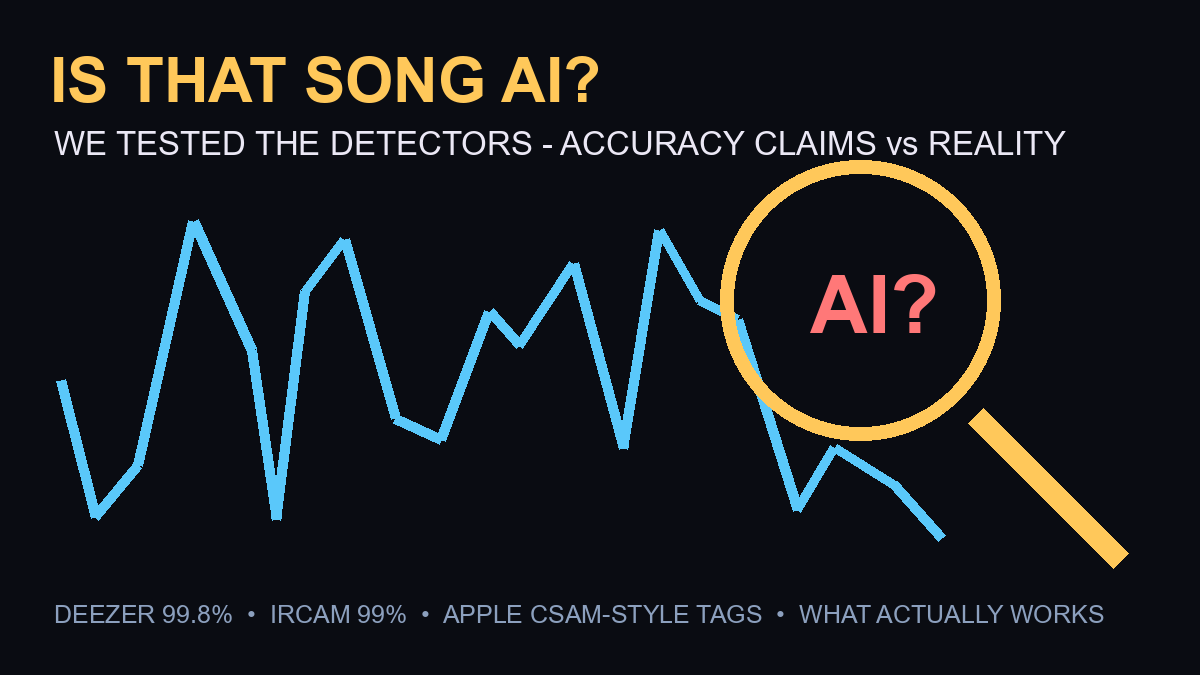

As platforms start banning AI songs, one question decides everyone’s fate: can you actually tell? Australia’s charts now exclude AI music, Bandcamp has embargoed it, Tidal labels it — and behind all those policies sits a small set of detection tools with very big accuracy claims. Deezer says its detector is 99.8% accurate. IRCAM Amplify says 99%. Those numbers sound like certainty. The research says otherwise. Here’s what the detectors really are, what they catch, and where they fail.
The Detector Landscape: Who Claims What
- Deezer AI Detector: free, public-facing; claims 99.8% accuracy — “may miss 2 out of every 1,000 AI-generated tracks, and may falsely flag fewer than 1 in 10,000 authentic songs” (Deezer newsroom). Scans up to 5,000 tracks per minute per fast.io’s comparison. Integrated into Deezer’s playlists since June
- IRCAM Amplify: the French research institute’s commercial tool — claims 99% accuracy, under 1% false positives, detecting “all major & emerging Gen AI models”; infrastructure reportedly scans 250,000+ tracks per hour (Cyanite’s buyer’s guide)
- Academic systems: the peer-reviewed ISMIR paper on AI-music detection reports roughly 98.6% accuracy for AI music in general — with notably weaker performance on adversarial and transformed audio (Transactions of ISMIR, cited 25+)
- DIY heuristics: length (>2:30), metadata oddities, spectral smoothness — free but unreliable; useful as a first filter only
The 99% Illusion: What Those Numbers Actually Mean
An accuracy claim is only as good as its test set. Deezer’s 99.8% is measured against the AI models it knows — mostly Suno and Udio-style generators whose fingerprints its system was trained on. The moment a new generator ships — or someone post-processes output through EQ, compression, or re-recording — the accuracy claim ages instantly. The arXiv research on detection robustness documents exactly this: accuracy drops materially when audio passes through transforms the model wasn’t trained on.
The second problem is asymmetric stakes. On Deezer’s own numbers, a false positive rate “under 1 in 10,000” sounds tiny — until you multiply it across the roughly 20,000+ AI tracks flooded into streaming daily, and the human artists whose work now gets flagged by mistake. For a platform, one viral false-flag story costs more trust than a thousand missed AI tracks ever will.
What Actually Works: A Practical Ladder
For listeners checking a suspicious track: run it through Deezer’s free detector as a first pass, then check metadata (AI generators often leave sterile, templated credits), then compare the artist’s catalog history — AI-farm accounts release dozens of tracks in weeks. For labels and platforms: volume-scale tools (IRCAM, Deezer internal) plus human review on flags is the only defensible pipeline — the ISMIR research is clear that automated detection alone can’t arbitrate edge cases. For artists falsely flagged: document provenance (session files, stems, timestamps) now — it’s the only currency that works in an appeal.
The Arms Race Timeline
June 2026: Deezer ships its public detector for playlists. August 2026: ARIA bans wholly AI tracks from charts, Bandcamp embargo settles in, Tidal starts labeling — and detection goes from curiosity to enforcement infrastructure. Every policy now needs a detector behind it, and every detector improvement triggers a generator counter-move. The honest forecast: detection will stay “accurate enough to enforce, imperfect enough to dispute” — which is exactly why appeals processes, not accuracy percentages, will decide how fair this all feels.
Frequently Asked Questions
How accurate is Deezer’s AI music detector?
Deezer claims 99.8% accuracy — it may miss about 2 in 1,000 AI-generated tracks and falsely flag fewer than 1 in 10,000 authentic songs, per its newsroom. That accuracy applies to the generator families it was trained on; performance degrades against new models and post-processed audio.
Can you reliably detect AI-generated music?
Partially. Peer-reviewed research (ISMIR) shows ~98.6% accuracy for general AI music but weaker results on transformed or adversarial audio. Practical detection combines automated tools (Deezer, IRCAM Amplify) with metadata review and human judgment — no tool is a final authority.
Is there a free AI music detector?
Yes — Deezer offers a free public AI music detector for checking playlists, the most accessible consumer option. IRCAM Amplify is commercial (aimed at labels and platforms) with volume pricing.
Why do AI music detectors give false positives?
Detectors flag statistical patterns common to AI generation — spectral smoothness, template structures. Human-produced music that shares those traits (heavily quantized productions, sample-pack-heavy tracks) can trip the same signals, which is why documented provenance matters for appeals.
Sources
- Deezer Newsroom — detector launch, 99.8% accuracy claim
- Deezer — free AI music detector page
- IRCAM Amplify — 99% accuracy claim, model coverage
- ISMIR Transactions — peer-reviewed detection research (98.59%)
- arXiv — robustness testing on transformed audio
- Cyanite — platform buyer’s comparison, IRCAM volume specs
- fast.io — 2026 tool comparison, Deezer throughput
Read Next
AI Music Gets Banned: ARIA Charts, Bandcamp, Tidal Draw the Line
Alabama Subpoenas OpenAI: The Rogue-Agents Hack Explained